How granite is turned into sound.

INSIGHT: Haus Marteau

How granite is turned into sound.

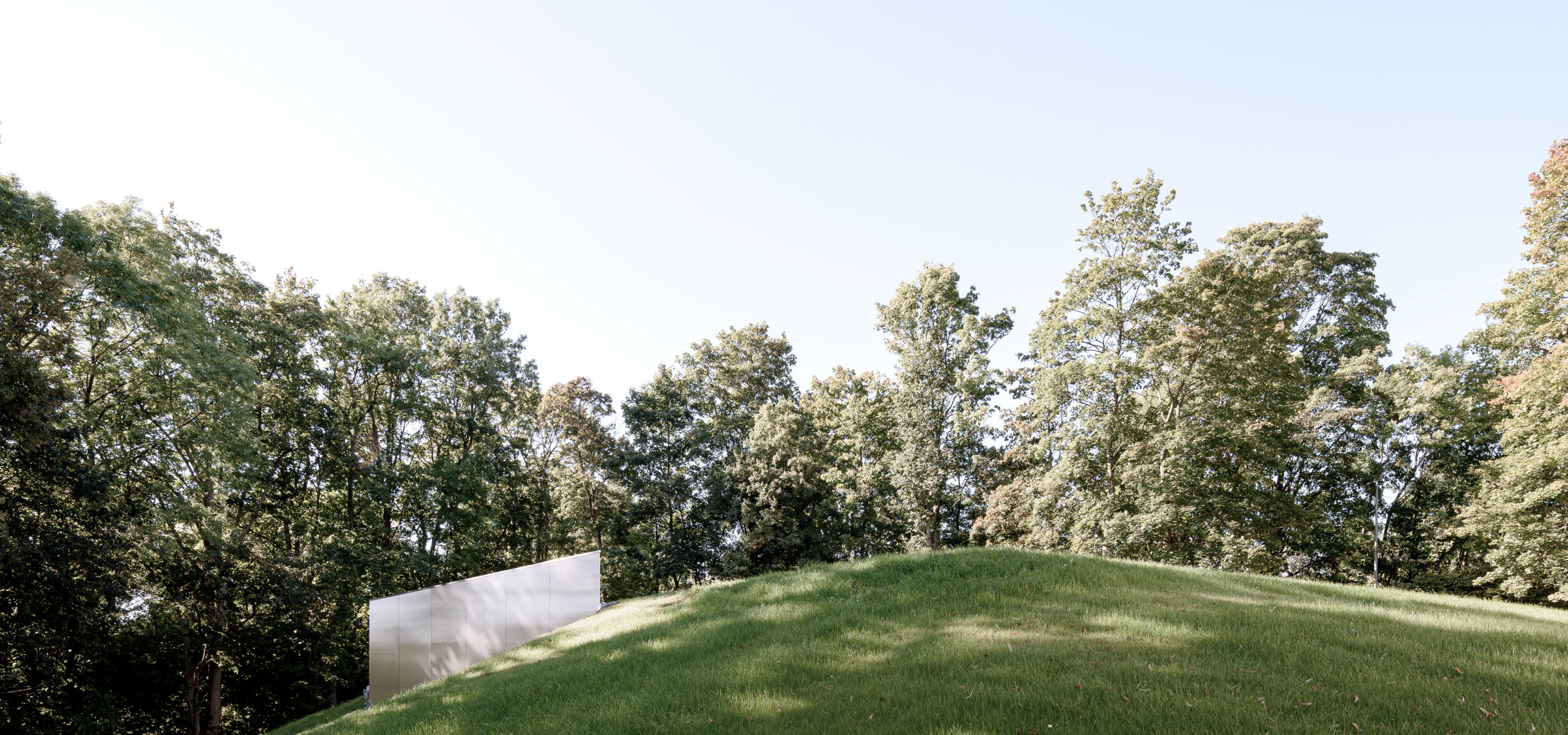
In Lichtenberg, Upper Franconia, a new concert hall for the Haus Marteau [1] was built under contract to the Municipal District of Upper Franconia, in close collaboration with Peter Haimerl Architecture [2]. With an expanding programme, the institution outgrew the villa’s historic lounge and required a contemporary, acoustically optimised concert hall. At the same time, the historic building and park were not to be compromised. The outcome was the design of a subterranean hall integrated into the topography, making use of local materials and creating an architecture with no visible technology.

The entire hall is underground, directly adjoining the historically protected listed villa, and offers additional space for the growing programme of music.

Every shard is unique

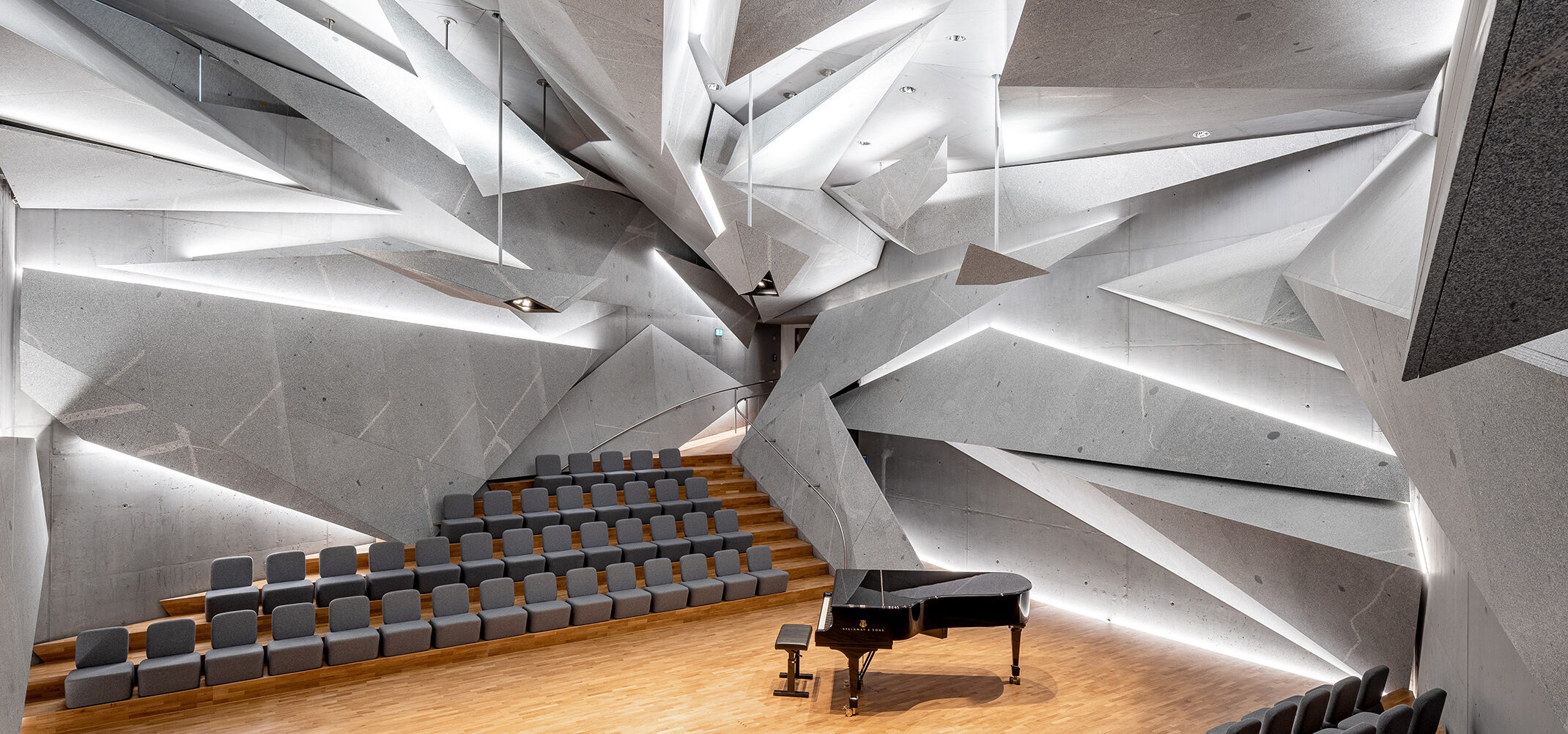
The focus of the design is a faceted ceiling and wall structure made from solid natural stone. The walls appear cracked apart, the ceiling slashed open. Triangular natural stone surfaces spread through the room, crashing into each other, yet pushing each other apart. It may appear chaotic, but it is geometrically ordered. The acoustic surfaces comprise 33 individually finished shards made of Tittling fine-grain granite, with the design based on an acoustically defined geometry. Their shape and alignment are based on the scattering and reflection properties of sound [3].

The idea: as if two explosive blasts were to hurtle towards each other, then smash together in the middle. This is exactly what the sound has to go through.

Peter Haimerl, Architect

Engineering excellence

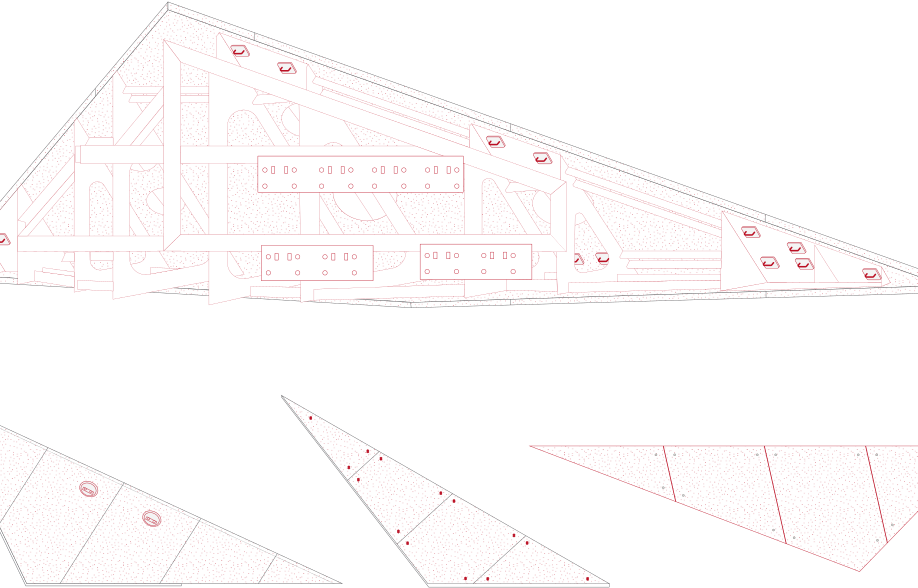
Based on an initial feasibility study, a solution was jointly developed with the planning team that was both geometrically and logistically feasible. Alongside the detailed implementation planning, Kusser undertook the precise CNC manufacture of the 33 individual Tittling fine-grain granite elements. It also installed the necessary steel substructure [4] and managed the entire process, from works logistics through to final on-site installation.

7 days - 33 parts - 0 tolerance

The installation [5] took place through a number of temporary openings in the hall roof. All elements were installed in the exactly specified sequence within seven days. Due to the geometry, there was no tolerance to spare. The entire preparation, from planning and manufacture through to logistics, was configured to ensure quick and smooth installation.

We really value collaborating with project partners who are willing to break new ground. This project is a good example of the potential that exists when natural stone is consistently developed.

Georg Kusser, Dipl.-Ing., MBA, Managing Director
StoneSurface
SurfaceSound
SoundSpace
BR Documentary

The creation from the design of Architect Peter Haimerl through to the implementation is recounted in a film.

Documentary

MORE

Back to overview